Gresham's Law and Alcoholics Anonymous - 4
inventory, admitting their faults, and making restitution on a regular basis, pray and meditate every day, go to two or more AA meetings weekly, and actively work the Twelfth Step, carrying the AA message to others in trouble.
The medium AA’s started off with a bang, pretty much like the strong AA’s, except they hedged or procrastinated a bit on parts of the program that they feared or did not like - maybe the God Steps, maybe the inventory Steps, depending on their particular nervousness or dislikes. But after they had stayed sober for a while, the medium AA’s eased up and settled into a practice of the program that went something like this: an AA meeting a week; occasional Twelfth Step work (leaving more and more of that to the "newer fellows" as time went on); some work with the Steps (but not like before); less and less inventory (as they became more and more "respectable"); some prayer and meditation still, but not on a daily basis any more (not enough time, due to the encroachment of business engagements, social activities, and other baggage that went along with the return to normal life in the workaday world).
The weak AA’s were a varied lot. The thing common to all of them was that they left big chunks of the program totally and permanently out of their reckoning right from the outset - sometimes the God Steps, sometimes the inventory Steps, often both. Weak AA’s tended to talk in terms like, "All you need to do to stay sober is go to meetings and stay away from the first drink." Most of the weak AA’s who were successful in staying sober were pretty faithful meeting-goers. Since they were doing so little with the principles, their sobriety and their survival depended more exclusively than did those of the strong and medium AA’s on constant exposure to the people of AA.
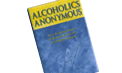
The fact is that only the strong-cup-of-coffee-ers were practicing the program as it had been laid out in the Big Book. Granting that the medium and weak AA’s had every right as AA members to practice the principles any way they wanted (including hardly any at all), since the Steps were "suggestions only" - still, the way the first members had done it, and the way the Big Book had recorded it was the strong-cup-of-coffee way.
The medium approach had - and still has - a real, constructive place in the AA recovery scheme, in that it can be used as a temporary platform for reluctant beginners. The medium-cup-of-coffee option enables many who initially are not up to the strong approach to gain a foothold in the fellowship of Alcoholics Anonymous. But medium AA can, and often does, become a trap. It is no place for an AA member to try to settle out permanently. People who stick too long in medium AA pass the point where they might be encouraged to step up to strong AA and end up sliding back into weak AA.
Weak AA has none of the redeeming features of medium AA. It is clearly at odds with the program as outlined in the Big Book. It bases itself on a flat and unnegotiable refusal to work with vital recovery principles. Weak AA’s cop out and stay copped out on most of the Twelve Steps. They water down the program to the point where there really is no program in the sense that the first members of AA understood the program. A more inclusive, more accurate, and more descriptive term than "weak AA" for this practice is "copped-out and watered-down AA", or COWD AA for short. With the passage of time, a definite evolution has taken place in AA in the respective popularity and acceptability of the strong and COWD approaches.
In the first years of their existence, the COWD AA’s tended to feel obligated to defend and sing the praises of their "heterodox" approaches and even to chide the strong AA’s a bit for being rigid and holier-than-thou. The strong AA’s, for their part, tended to be more relaxed and tolerant, less strident, less defensive. After all, their method was obviously safer since it involved taking more of the medicine. And it was obviously the original and genuine article as the Big Book eloquently attested
But this juxtaposition of attitudes came to have a peculiar effect in a movement which prided itself on its goodnatured inclination to let all kinds of maverick opinions and practices have their say and their way. The loudest voices came to be the voices of heterodoxy, and these came in time to have the greatest impact on newcomers. Copped-out and watered-down AA came to be the "in" thing, the wave of the future; strong AA came to be regarded - not universally, but widely - as a bit stodgy and a bit passé.
The COWD AA’s had in a sense proven Bill and the first hundred AA’s wrong. In the introduction to the Twelve
Steps, the statement:
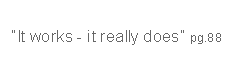
"...we thought we could find an easier, softer way, but we could not..." was an unequivocal assertion that it was
necessary to practice all the Steps. But the COWD AA’s did not practice all the Steps, and they were staying
sober. They had found an easier, softer way. Human nature being what it is, it was inevitable that the less
demanding, medium-to-weak approach would grow in popularity while the older, more rigorous approach would