Gresham's Law and Alcoholics Anonymous 2
That short paragraph was a stroke of inspiration, especially the phrase, “We are not saints.” It has eased thousands of new, half convinced AA members (myself included) past the fact that we were headed, under the guidance of the Steps, in the completely unfamiliar direction of spiritual perfection.
Most of us began practicing the Steps without realizing their full implications. Experience quickly taught us that they worked. They got us sober and enabled us to stay sober. From our intensely pragmatic standpoint, that was what mattered. We were content to enjoy our sobriety and leave all debates as to why the Steps worked to non-alcoholic theorizers - whose lives did not hang in the balance if they got themselves confused and came to some wrong conclusions.
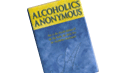
AA's founders did something else to keep the spiritual rigor and power of the Twelve Steps from scaring off new prospects. They put the Steps forth as suggestions rather than as directives. The sentence which introduces the Steps in chapter five of the Big Book says, “Here are the steps we took, which are suggested as a program of recovery.” This idea had enormous appeal throughout the AA movement from the time the Big Book was first published. We drunks hate to be told to do anything. The freedom to take the Steps at their own pace and in their own way quickly grew to be deeply cherished among AA members.
Before we explore the results of this permissive approach to the Steps, there is one oddity worth noting. AA existed for four full years before the Steps were put in their final written form. During that time there was a program and it was sobering up alcoholics. It consisted of two parts: a Six-step word-of-mouth program, and the Four Absolutes - absolute honesty, absolute purity, absolute unselfishness, and absolute love - taken over from the Oxford Group, the evangelical Christian movement out of which AA was born.
The six steps of the word-of-mouth program from the early pioneering years of Alcoholics Anonymous as given
in "Alcoholics Anonymous Comes of Age" are:
1. We admitted that we were powerless over alcohol.
2. We made a moral inventory of our defects or sins.
3. We confessed or shared our shortcomings with another person in confidence.
4. We made restitution to all those we had harmed by our drinking.
5. We tried to help other alcoholics with no thought of reward in money or prestige.
6. We prayed to whatever God we thought there was for power to practice these precepts.
In those early days of AA there was no talk of suggestions. The basic points of the program, were regarded by all the older members as directives, as indispensable essentials, and were passed on to newcomers as such.
When Bill first formulated the Twelve Steps, he conceived of them, too, as instructions, not as suggestions. When the idea of presenting the Steps as suggestions came up, Bill for a long time flatly opposed it. Finally - and reluctantly - he agreed. In "Alcoholics Anonymous Comes of Age" he related how this concession enabled countless AA’s to approach the fellowship who would otherwise have been turned off AA - and back to active alcoholism.
Still, Bill was a man whose watchword was prudence and who went out of his way to steer clear of destructive controversy. One cannot help wondering if his feelings on the decision to present the Twelve Steps in the form of suggestions were not a bit more ambiguous than he was willing to let on in public once the compromise had been reached. There is no denying that the paragraphs of chapter five of the Big Book which introduce the Twelve Steps are full of language that would be utterly appropriate as a preamble to a set of action directions, but is not nearly as fitting as an introduction to a group of suggestions. Here is the beginning of chapter five, with the key words and phrases underlined:
“Rarely have we seen a person fail who has thoroughly followed our path. Those who do not recover are people who cannot or will not completely give themselves to this simple program, usually men and women who are constitutionally incapable of being honest with themselves. There are such unfortunates. They are not at fault; they seem to have been born that way. They are naturally incapable of grasping and developing a manner of living which demands rigorous honesty. Their chances are less than average. There are those, too, who suffer
 |